Jewelry with Spirit · Stories in Every Piece
Nara Charm

Symbolism

Understanding Chakra Jewelry: Complete Beginners Guide

Complete beginners guide to chakra jewelry — what it is, the 7 chakras and their colors, how chakra bracelets work, and how to choose the right chakra stones for your energy needs.

By Nara Charm·Jul 25, 2026·6 min readNew

What Is Chakra Jewelry?

Chakra jewelry is jewelry — typically bracelets, necklaces, or pendants — designed to work with the body's seven main energy centers, or chakras. The word "chakra" comes from Sanskrit, meaning "wheel" or "disk," referring to the spinning energy vortices that, according to ancient Indian tradition, exist along your spine from its base to the crown of your head.

Each chakra governs specific physical, emotional, and spiritual aspects of your being. When a chakra is balanced — spinning freely and evenly — the corresponding areas of your life tend to function well. When a chakra is blocked, overactive, or underactive, you may experience challenges in those areas.

Chakra jewelry works by placing stones associated with specific chakras against your skin, allowing their unique energetic frequencies to interact with your body's energy system. The most common form is the seven-stone chakra bracelet, which includes one stone for each of the seven main chakras in sequence.

The 7 Chakras and Their Stones

Root Chakra (Muladhara) — Color: Red. Location: Base of the spine. Stones: Red jasper, hematite, garnet, black obsidian. Governs: Survival, safety, grounding, physical stability. A balanced root chakra makes you feel secure and at home in your body.

Sacral Chakra (Svadhisthana) — Color: Orange. Location: Lower abdomen. Stones: Carnelian, orange calcite, sunstone. Governs: Creativity, sexuality, passion, emotional flow. A balanced sacral chakra allows you to experience pleasure and creative expression freely.

Solar Plexus Chakra (Manipura) — Color: Yellow. Location: Upper abdomen. Stones: Citrine, tiger's eye, yellow jasper. Governs: Personal power, confidence, willpower, self-esteem. A balanced solar plexus chakra gives you a healthy sense of personal authority.

Heart Chakra (Anahata) — Color: Green or Pink. Location: Center of the chest. Stones: Rose quartz, jade, aventurine, malachite. Governs: Love, compassion, forgiveness, emotional balance. A balanced heart chakra allows you to give and receive love freely.

Throat Chakra (Vishuddha) — Color: Blue. Location: Throat. Stones: Lapis lazuli, turquoise, aquamarine, sodalite. Governs: Communication, self-expression, truth. A balanced throat chakra helps you speak your truth with clarity and confidence.

Third Eye Chakra (Ajna) — Color: Indigo. Location: Forehead, between the eyebrows. Stones: Amethyst, lapis lazuli, fluorite, clear quartz. Governs: Intuition, insight, imagination, spiritual awareness. A balanced third eye chakra enhances your inner knowing.

Crown Chakra (Sahasrara) — Color: Violet or White. Location: Top of the head. Stones: Clear quartz, amethyst, selenite, white howlite. Governs: Spiritual connection, enlightenment, consciousness. A balanced crown chakra connects you to something greater than yourself.
How Chakra Bracelets Work

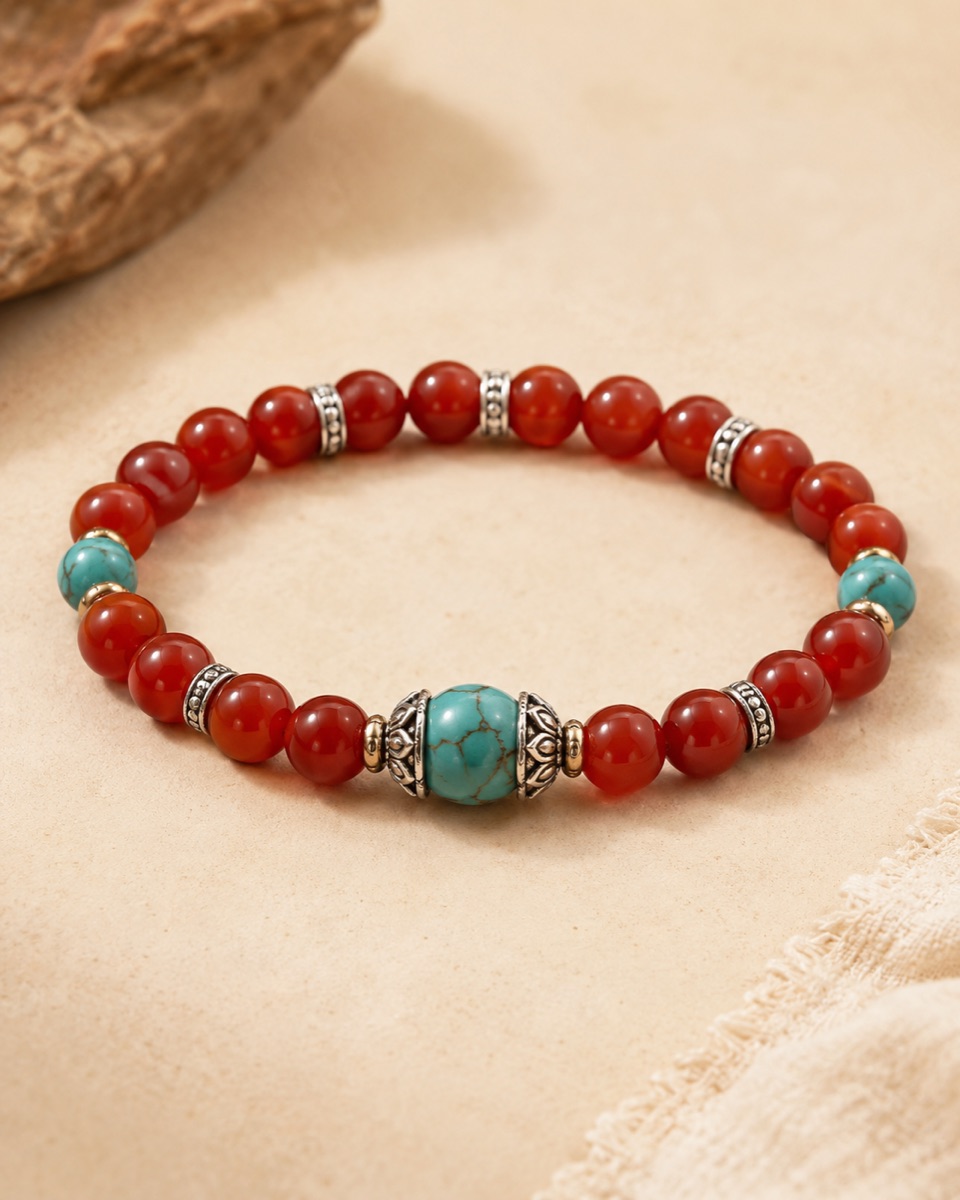
A typical chakra bracelet contains seven beads, one for each chakra, arranged in order from root (red) to crown (violet or clear). When worn on the wrist, the stones are positioned along the arm's energy meridians, which connect to the spinal column where the chakras are located.

The bracelet format is especially effective for chakra work because the wrist is close to major energy channels. As you move your hands throughout the day, the stones on a chakra bracelet gently stimulate different meridian points, helping to keep your entire energy system in balance.

Some chakra bracelets use the actual colors of the chakras (red, orange, yellow, green, blue, indigo, violet), while others use stones that energetically correspond to each chakra even if their color is not exact. Both approaches work — the energy of the stone matters more than its visual color.

Many crystal enthusiasts wear their chakra bracelet daily as a preventative energy practice. Rather than waiting for a specific chakra to feel blocked, the daily wearing of all seven stones helps maintain overall energetic balance — like taking a multivitamin for your energy system.

How to Choose the Right Chakra Jewelry

Start with a seven-stone bracelet. If you are new to chakra work, a complete seven-stone chakra bracelet is the best starting point. It gives you a baseline of balanced energy and helps you learn how each chakra feels when it is supported by its corresponding stone.

Target specific chakras if you know your imbalances. If you already know which chakra needs attention — for example, you struggle with communication (throat chakra) or feel ungrounded (root chakra) — you can add a bracelet made entirely of the corresponding stone: lapis lazuli for throat, garnet for root, and so on.

Trust your physical response. When choosing chakra stones, pay attention to how your body responds. You may feel warmth, tingling, or a sense of calm when you hold the right stone. Conversely, some stones may feel uncomfortable or heavy — that can indicate a chakra that needs healing but is resistant to opening.

Cleanse your chakra jewelry regularly. Chakra stones absorb energy throughout the day and need regular cleansing. Moonlight charging (overnight on a windowsill) works for all chakra stones. Some stones (like selenite and clear quartz) can be used to cleanse other stones in the set.

Continue Reading

Comments

Loading comments...

Leave a Comment