Symbolism
Tibetan Jewelry Symbols & Meanings: A Guide to Sacred Adornment
Explore the meaning behind Tibetan jewelry symbols — the lotus, endless knot, turquoise, and Dzi beads. Learn what these sacred symbols mean and why they're worn.
Symbolism
Explore the meaning behind Tibetan jewelry symbols — the lotus, endless knot, turquoise, and Dzi beads. Learn what these sacred symbols mean and why they're worn.
Tibetan jewelry is unlike jewelry from any other tradition. At the roof of the world — where the air is thin, the sky presses close, and the landscape is vast and unforgiving — every object made by hand must justify the effort of its making.
This means Tibetan jewelry is never purely decorative. Each piece carries meaning, blessing, or protection. Symbols are not chosen for aesthetics alone — they are chosen for what they do, for the spiritual power they are believed to hold.
If you wear Tibetan jewelry, you are carrying a tradition that has been shaped by altitude, faith, and centuries of devotion.
The Lotus (Padma) — The lotus is one of the most important symbols in Tibetan Buddhism. It represents purity — specifically, the ability to rise above difficult circumstances (represented by mud) and bloom into something beautiful. A piece of jewelry with a lotus is a reminder that you can grow through hardship.
The Endless Knot (Shriovatsa) — This intricate, interwoven knot symbolizes the interdependence of all things. It has no beginning and no end, representing the infinite nature of wisdom and compassion. It is one of the Eight Auspicious Symbols of Buddhism.
The Dharma Wheel (Dharmachakra) — The wheel represents the teachings of the Buddha and the cycle of spiritual growth. Its eight spokes correspond to the Noble Eightfold Path.
The Conch Shell (Dungkar) — The conch symbolizes the spreading of truth and the deep, far-reaching sound of the Dharma. It is often used as a trumpet in Tibetan ceremonies.
The Vajra (Dorje) — The vajra, or "diamond thunderbolt," symbolizes the indestructible nature of wisdom and the power to cut through ignorance. It is a symbol of spiritual authority.
Turquoise is the most important stone in Tibetan jewelry — so important that it is almost inseparable from Tibetan identity. As we explore in our turquoise meaning guide, Tibetans consider turquoise a piece of the sky that fell to earth.
In Tibetan jewelry, turquoise is:
- Given to children at birth for protection and good fortune
- Set into silver rings, bracelets, and pendants
- Combined with coral (red) to represent the union of sky and earth
- Worn throughout life and often buried with the deceased
No piece of Tibetan jewelry feels complete without at least one turquoise stone.
Dzi beads are perhaps the most mysterious and coveted item in Tibetan jewelry. These agate beads, with distinctive eyes or line patterns, are believed to be of divine origin — some traditions say they were dropped by gods, others that they were insects turned to stone.
Dzi beads are worn for protection, good fortune, and spiritual power. The number of "eyes" on a Dzi bead carries specific meanings:
- 1-eye Dzi: clarity, brilliance, and success
- 3-eye Dzi: wealth, health, and longevity
- 9-eye Dzi: the most coveted — ultimate protection and good fortune
Authentic ancient Dzi beads can sell for tens of thousands of dollars. Modern Dzi-style beads are more affordable but still carry the symbolic meaning.
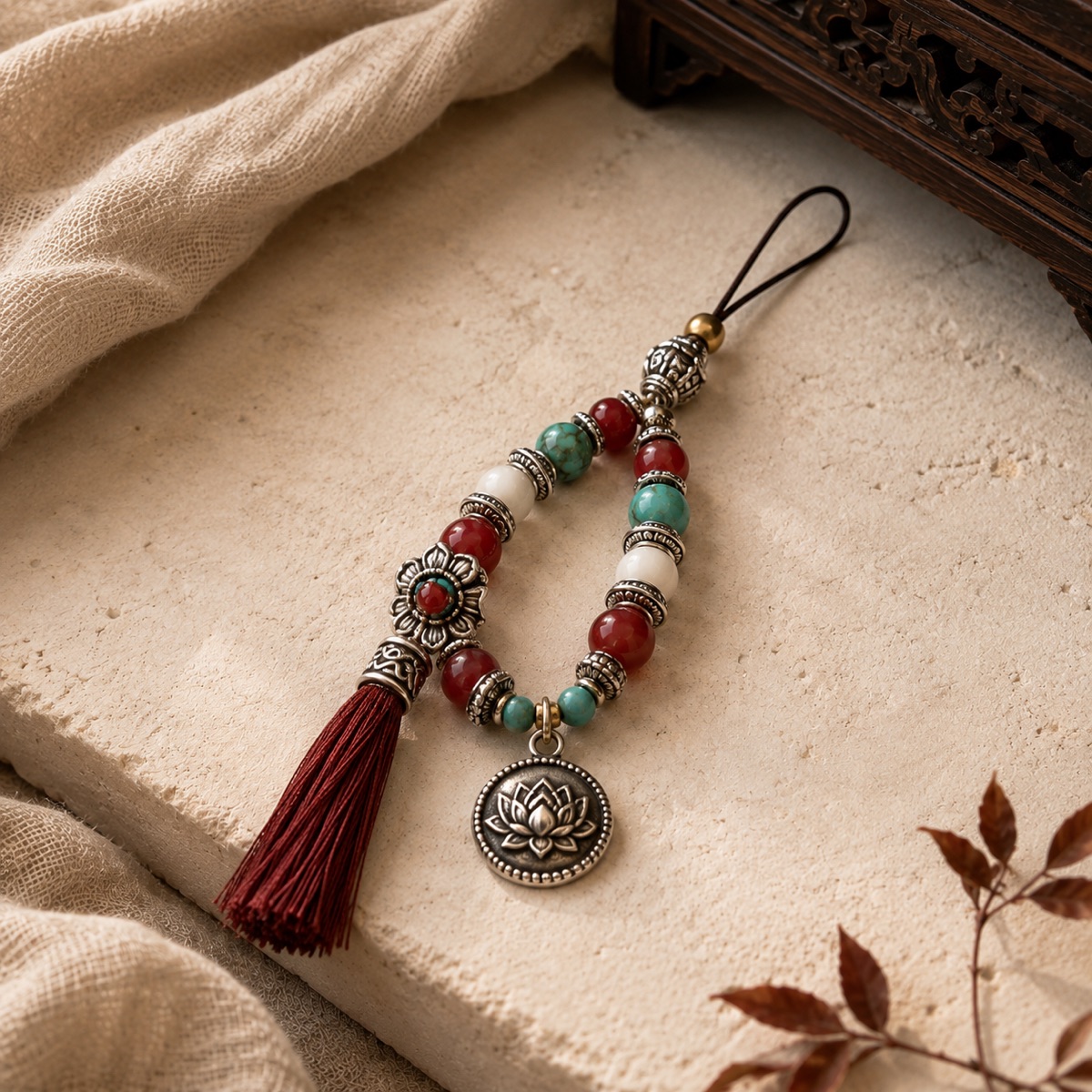
When shopping for Tibetan jewelry, you'll often see "Tibetan silver" — but this is different from sterling silver:
Sterling silver (925) is 92.5% pure silver, a globally recognized standard.
Tibetan silver is a traditional alloy that historically contained silver, but modern "Tibetan silver" is often a mix of copper, nickel, and other metals with a silver-like appearance.
At Nara Charm, we use genuine 925 sterling silver in our Tibetan-inspired pieces, combined with traditional hand-chasing techniques. Shop our Tibetan Amulet 925 Bracelet →
When choosing Tibetan jewelry for its spiritual meaning:
Look for symbols that resonate. Choose a lotus for growth, an endless knot for connection, turquoise for protection. Let the meaning guide you.
Check the materials. Real turquoise has matrix lines and natural variation. Real silver has weight and develops a patina. If it looks too perfect, it may be synthetic.
Respect the tradition. Tibetan symbols are sacred. Wear them with awareness of their meaning, not just as fashion.
Crystal Meanings
Discover the meaning and healing properties of amethyst — the stone of calm, protection, and spiritual wisdom. Learn what amethyst does, its benefits, and how to wear it.
Crystal Meanings
Discover the meaning and healing properties of turquoise — a sacred stone of protection, wisdom, and the sky. Learn what turquoise means across cultures and how to wear it.
Symbolism
Discover the ancient art of Miao silver filigree — a technique where silver is drawn finer than human hair. Learn the history, process, and cultural meaning of this endangered craft.